




Custom Aluminum-Laminated Cardboard is becoming an important solution for packaging applications where ordinary paperboard cannot provide sufficient protection against moisture, oxygen, light, and odor transfer. ZHONGYI, a professional China manufacturer and supplier of specialty cardboard, combines paperboard substrates with 7–12 μm aluminum foil or aluminized film through controlled thermal lamination to create packaging materials for food, gifts, electronics, chemicals, cold-chain logistics, and export applications.
Aluminum-laminated cardboard combines the structural strength and processing flexibility of paperboard with the barrier characteristics of an aluminum layer. Depending on the application, manufacturers can select solid aluminum foil or vacuum-metallized PET film, different substrate types, 1.5–5 mm standard thicknesses, and single- or double-sided lamination. The resulting composite board can help reduce moisture penetration, oxygen exposure, light transmission, odor loss, and condensation-related packaging problems. This article explains its structure, material selection, protection advantages, customization options, applications, quality considerations, and practical purchasing factors.
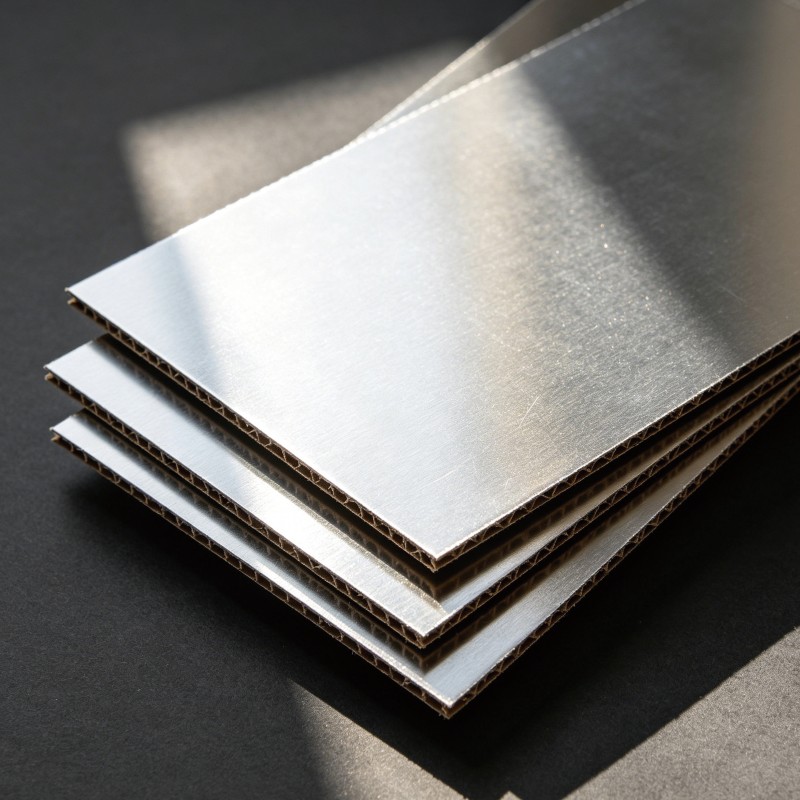
Table of Contents
- What Is Custom Aluminum-Laminated Cardboard?
- How Is the Composite Structure Designed?
- What Protection Advantages Does It Offer?
- Key Specifications and Customization Options
- Where Is Aluminum-Laminated Cardboard Used?
- How Should Buyers Select the Right Material?
- Quality Control and Processing Considerations
- Frequently Asked Questions
- Conclusion and Custom Packaging Support
What Is Custom Aluminum-Laminated Cardboard?
Aluminum-laminated cardboard is a composite paperboard material formed by bonding an aluminum foil or aluminized film layer to a rigid paper-based substrate. Unlike conventional paperboard, which primarily provides structural support, this composite construction adds barrier functions that are valuable when packaging must withstand moisture, oxygen, light, or odor exposure.
The lamination process uses controlled-temperature hot pressing to create a stable bond between the aluminum layer and the selected board. Depending on the end use, the substrate may include grey board, white board, kraft linerboard, specialty paperboard, or corrugated board.
This structure allows buyers to customize the board around the actual packaging environment rather than selecting a single standardized material for every application.
How Is the Composite Structure Designed?
There are two major aluminum-layer configurations, and the choice depends on the required barrier performance, appearance, application, and budget.
| Composite Structure | Typical Material | Main Characteristics | Typical Applications |
|---|---|---|---|
| Solid Aluminum Foil | 7–12 μm aluminum foil | High barrier against moisture, oxygen, light and odor | Tea, dried foods, herbs, chemicals, export packaging |
| Vacuum-Metallized Film | PET substrate with aluminum coating | Metallic appearance with basic barrier protection and cost efficiency | Gift boxes, decorative boards, cultural products |
Solid aluminum foil is generally selected when barrier performance is the priority. Vacuum-metallized film can be considered when visual appearance, moderate protection, and cost control need to be balanced.
What Protection Advantages Does It Offer?
Moisture and Water Vapor Resistance
Paperboard can absorb moisture under unfavorable storage or transportation conditions. An aluminum layer provides an additional barrier that helps reduce moisture transfer and protects the board from humidity-related performance changes. This is particularly useful for dry foods, powdered materials, and long-distance shipping.
Oxygen and Oxidation Protection
Oxygen exposure can contribute to oxidation and quality deterioration in sensitive products. Aluminum foil offers a dense barrier that helps limit oxygen transmission, making laminated board suitable for applications where oxidation control is important.
Light Shielding
Light-sensitive materials may experience quality changes when exposed to prolonged illumination. The metallic aluminum layer can significantly reduce light transmission, making it useful for packaging structures that require light protection.
Odor and Aroma Retention
For products where aroma retention matters, the aluminum barrier can help reduce unwanted odor exchange. Tea, coffee, herbs, and other dry products can benefit from a packaging structure designed to better isolate the contents from the surrounding environment.
Reflective and Thermal Properties
The reflective surface can help reduce the impact of radiant heat. When used as part of a broader cold-chain or export packaging system, aluminum-laminated board can provide auxiliary thermal and condensation-control functions, although it should not be treated as a replacement for a complete thermal insulation system.
Key Specifications and Customization Options
One of the main benefits of this material is the ability to configure the composite structure according to packaging requirements.
| Specification | Available Options | Selection Consideration |
|---|---|---|
| Aluminum Foil Thickness | 7 μm, 9 μm, 12 μm | Higher barrier requirements generally call for thicker foil |
| Board Thickness | Typically 1.5–5 mm | Depends on rigidity, cushioning and structural requirements |
| Laminate Side | Single-sided or double-sided | Selected according to barrier and processing requirements |
| Substrate | Grey board, white board, kraft, specialty or corrugated board | Determines rigidity, printability and cushioning characteristics |
| Surface Finish | Glossy or matte aluminized film | Important for decorative and premium packaging |
| Processing | Cutting, die-cutting, slotting and other processing | Should match the customer's packaging production line |
Custom dimensions and non-standard cutting are also possible. Large sheets can be supplied as finished materials, while pre-cut or semi-finished components can simplify downstream packaging production.
Where Is Aluminum-Laminated Cardboard Used?
The combination of rigidity and barrier protection makes this material suitable for several industries.
- Tea and traditional herbal products: Used as gift-box inserts and internal boards where moisture, light, and aroma protection are important.
- Dry food packaging: Suitable for coffee, nuts, baked products, health supplements, and other moisture-sensitive products.
- Electronics: Used as protective liners and separators to reduce exposure to humidity and condensation during transportation.
- Chemical products: Can be used as internal barrier materials for selected powdered or moisture-sensitive industrial products.
- Cold-chain logistics: Used as part of moisture-resistant and reflective packaging structures.
- Ocean freight: Helps address condensation and high-humidity conditions commonly encountered during long-distance maritime transportation.
- Premium gift packaging: Metallized surfaces provide a distinctive metallic appearance for premium cultural and creative products.
How Should Buyers Select the Right Material?
Choosing the correct laminate should begin with the packaging environment rather than the appearance of the material alone. Buyers should evaluate the product, transportation route, storage period, humidity, required barrier performance, downstream processing method, and target cost.
1. Define the Protection Requirement
For high-humidity environments, long-distance ocean transportation, or sensitive dry goods, a solid aluminum foil structure may be appropriate. For decorative applications requiring moderate moisture and light protection, aluminized film may provide a practical alternative.
2. Select the Substrate
Rigid grey board can support gift-box structures, while kraft-based or corrugated substrates can provide different combinations of strength and cushioning. The substrate should be selected according to the finished packaging design.
3. Decide Between Single- and Double-Sided Lamination
Single-sided lamination can leave a paperboard surface available for printing or mounting. Double-sided lamination provides barrier protection on both sides and can be useful for separators and liners.
4. Confirm Downstream Processing
If the board will be die-cut, bent, slotted, folded, or glued, the composite structure should be tested before mass production. Sampling helps confirm adhesion, surface condition, cutting performance, and dimensional stability.
Quality Control and Processing Considerations
Consistent lamination quality is essential because poor bonding can result in bubbles, wrinkles, peeling, or delamination during storage and processing. A professional production process should therefore control both incoming materials and the lamination operation.
ZHONGYI's product information indicates quality checks covering baseboard stiffness, flatness, moisture content, lamination temperature, bonding pressure, aluminum-film appearance, peel strength, bending performance, cutting dimensions, and edge flatness. The company also states that its aluminum-laminated cardboard has undergone SGS and RoHS environmental testing, while food-grade variants are supported by food-contact safety reports.
For international buyers, documentation can be especially important. Depending on the project, buyers may need material specifications, testing reports, food-contact documentation, environmental compliance information, packaging specifications, and sample approval records.
For further material selection, buyers can also review related custom specialty cardboard solutions and compare them with conventional paperboard according to the required protection level.
Frequently Asked Questions
What is the main difference between aluminum-laminated cardboard and PE-coated paperboard?
PE-coated paperboard mainly provides water and moisture resistance. Aluminum-laminated cardboard can provide a broader barrier against moisture, oxygen, light, and odor transfer, making it suitable for applications requiring more comprehensive protection.
What aluminum foil thicknesses are available?
Common solid aluminum foil options include 7 μm, 9 μm, and 12 μm. The appropriate thickness depends on the required barrier performance and packaging environment.
Can the cardboard be die-cut after lamination?
Yes. The composite structure is designed to support further processing such as cutting, die-cutting, slotting, bending, and gluing. Sample testing is recommended before high-volume production to confirm compatibility with a specific process.
Is aluminum-laminated cardboard suitable for food packaging?
Food-grade versions can be produced with appropriate food-contact materials and supporting safety documentation. However, buyers should confirm the exact grade, intended food-contact conditions, and applicable compliance documents before using the material for direct food contact.
Can the material be customized for ocean freight?
Yes. For ocean freight and high-humidity environments, buyers can specify a higher-barrier aluminum foil structure, suitable substrate, thickness, and single- or double-sided lamination. The complete packaging system should still be designed according to the product and transportation conditions.
Can custom-cut or pre-die-cut sheets be supplied?
Yes. Custom dimensions, cutting, and semi-finished die-cut components can be arranged according to project requirements. Providing drawings, dimensions, material requirements, and expected order quantities can help accelerate technical evaluation.
Conclusion and Custom Packaging Support
For packaging applications that require more than basic paperboard protection, Custom Aluminum-Laminated Cardboard provides a configurable combination of structural support and multi-layer barrier performance. By selecting the right aluminum layer, substrate, thickness, lamination configuration, and downstream processing method, manufacturers can develop packaging structures for dry foods, gifts, electronics, chemicals, cold-chain applications, and international transportation.
With more than 20 years of packaging-industry experience, an intelligent production base, automated lamination and cutting capabilities, and quality-control procedures covering raw materials through finished products, ZHONGYI supports both prototype development and larger-volume customized orders. If you are evaluating material thickness, foil structure, board substrate, die-cut dimensions, or export packaging requirements, contact us with your specifications and application details to discuss a suitable aluminum-laminated cardboard solution.

